This is the third in our series of blog posts showcasing work presented at ESD Exchange. Steve’s talk takes place on day one of the ESD Exchange conference on April 16th 2026.
Sustainability in higher education often feels like an ambition everyone agrees with but few have succeeded in implementing meaningfully. Across the sector, we see passionate individuals, creative projects, and pockets of innovation — yet students’ experiences are still uneven, and opportunities often depend on chance, not design.
So let me start with a story.
Meet Rhona. She’s not a sustainability student. She hasn’t signed up for an environmental degree. She’s a first‑year psychology student, new to the University and unsure how sustainability connects to her discipline or her future career. Like many students, she assumes sustainability is important “in general” but not necessarily relevant to her.
Then something changes.
Rhona completes a short online induction exploring sustainability, the SDGs, and why these ideas matter in her subject area. Suddenly, the dots start joining. She begins to see how mental health, wellbeing, justice, and community resilience are all part of the wider sustainability picture. And with that spark of recognition, she takes her next step.
What follows for Rhona is not a linear module or a prescribed sequence of tasks, but a pathway — structured enough to guide her, flexible enough to follow her interests, and supported enough to help her grow. She moves from curiosity to participation, from participation to confidence, and from confidence to leadership.
Her story prompts an important question:
Could every student have a journey like Rhona’s — and if not, what would it take to make that possible?
How do we make it happen?
As an Education lead for Sustainability at my University, I am accustomed to pushback. Not in the sense of climate denial or scepticism; indeed, many of my colleagues are convinced about the need for sustainability in education, and not just as a cosmetic addition. Rather, I hear two pretty consistent messages
- This sounds great — I’m completely on board…
- …as long as we don’t have to spend money or add to colleagues’ workload.
Does this sound familiar?
If so, you may also be grappling with the challenge of embedding meaningful sustainability development for all students. At the University of Bath, as in many institutions across the sector, sustainability opportunities are plentiful but often fragmented. Strong individual initiatives may lack integration with each other or with the formal curriculum.
The challenge is to bring these elements together into a coherent framework that provides genuine value for students, develops skills sought by employers, and supports societal impact.
This is why I have been leading work on a coherent, scalable framework that unites these activities — without requiring significant additional resource or adding burden to staff or students.
A 3 level framework for embedding Sustainability
The framework builds on existing course designs — where sustainability is often embedded “on paper” but not consistently enacted in practice — and offers students an accredited pathway comprising three progressive levels: Sustainability Citizen, Sustainability Advocate, and Sustainability Leader.
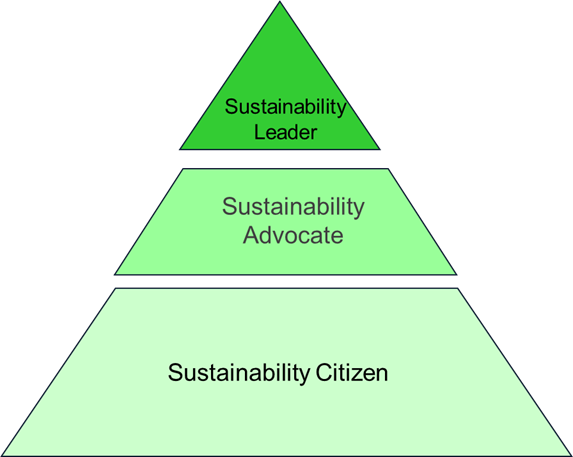
- Citizen: the minimum level for all students. Embedded across all programmes, it focuses on foundational knowledge of sustainability, the SDGs, and discipline‑specific relevance, supported by competencies in systems thinking, values‑led reasoning, and problem‑solving.
- Advocate: builds on the infrastructure of an existing careers framework by incorporating sustainability activities that students can claim credit for. Many involve external partnerships such as Carbon Literacy, Climate Fresk, Vertically Integrated Projects, and One Young World.
- Leader: a bespoke programme for students who apply for it, run by the central Sustainability Team. To qualify, students must demonstrate leadership of a sustainability initiative — for example a campaign, research project, student representative role, or leadership within a relevant club or society.
The table below summarises proposed learning outcomes across the three levels — covering knowledge, competencies, and behaviours. These are still subject to consultation and challenge from staff, students, and employers.
| Level | What do they know | What can they do | How do they behave |
| Sustainability Citizen | Sustainability as a holistic conceptThe SDGS Relevance of sustainability to their discipline / careerOptions available to continue to Advocate/Leader | Sustainability competencies | Critical ThinkerTeam player |
| Sustainability Advocate | Basic pedagogy including facilitation and listening Team workingDeep dive into an area of sustainability relevant to you (eg discipline/career) | Facilitate discussionCo-lead workshops | Deliver on promiseSeek out areas to make a differenceActive listenerCuriousGrowth mindset |
| Sustainability Leader | Theories of change including behaviour change and organisational changeLeadership skillsStakeholder management | Lead a team (or sub team)Work with stakeholdersInfluence change | Lead/co lead an initiativeHave impact within and even beyond the University |
Within the framework, all courses will embed the Citizen level, and encourage students to apply for Advocate and Leader. Embedding, in practice, does not mean redesigning the course, nor changing assessments or ILOs. Rather, it usually means educators making the sustainability implications of their teaching more explicit, and highlighting the relevance of sustainability to the subject. In some cases, sustainability‑themed case studies can be introduced where appropriate.
The table below gives an indicative list of the effort required.
| What course leaders need to do | What the Sustainability Team provide |
| Promote the framework to teaching staff on the programme | Assets such as slidesets and posters, availability of Education Lead if useful |
| Schedule a workshop with teaching staff (and ensure good attendance) to help identify ways to more firmly embed (and/or make more visible) sustainability in the course | Design, lead and facilitate the workshop |
| Signpost staff to help, guidance and resources such as case studies | Contacts for help and guidance Resources including case studies |
| Review the course to assure that the Citizen level is covered for all students. This may require conversations with teaching staff. | Assist with review |
| Promote the framework to students, including the relevance of sustainability to their subject, and opportunities to progress to Advocate and Leader. | Assistance, including assets such as slidesets and posters |
| Require all students to complete a short sustainability induction course (online) | Induction course is designed and created by the Sustainability Team. |
By offering a unified, resource‑sensitive structure that connects curriculum, co-curriculum, and external partners, this framework aims to develop graduates equipped with the sustainability mindsets and capabilities demanded by employers and society.
Next steps include piloting the framework across multiple departments, gathering feedback from staff and students, and evaluating its impact on learning, confidence and employability.
Longer term, we hope to collaborate with other institutions and I invite you to contact me directly if you would like to compare approaches and explore how we can work together to deliver sector‑wide, systemic change in sustainability education.
This blog is based on my talk at the ESD Exchange conference, delivered on 16/17 April 2026, entitled “Building a Coherent, Scalable Framework for Embedding Sustainability Pathways Across the Curriculum”
Steve Cayzer
Professor of Climate Education
University of Bath
