Originally posted at Are we preparing students for a future that won’t happen?, Dr Sandra Lee, Social Impact Lead for Sustainability for the University of Leicester discusses careers, sustainability, and the identity gap in careers education.
The real skills gap may be less about skills and more about professional identity.
I’ve had so many aha moments from conferences over the years – the odd soundbite from a keynote, insight from a workshop, even a great chat in the lunch queue but at the ESD (Education for Sustainable Development) Exchange conference last week, my aha came from noticing a trend in the q&a following each workshop. I found myself in room after room of thoughtful, committed educators asking the same questions.
- How do we prepare students for a future that feels increasingly uncertain?
- How do we engage young people distracted by AI and technology?
- How do we help them care about the natural world?
We often encourage young people deciding on a career path to find something that gives them satisfaction and purpose but that’s a tough thing to figure out when you haven’t landed on who you are yet.
We don’t just choose jobs, we choose identities
This was familiar ground for me. My PhD focussed on identity but in a behavioural context, rather than professional, ‘future of the workforce’ sense. Decades of research in Identity Theory show that behaviour isn’t driven by information alone. It’s shaped by identity—our sense of who we are, what we value and where we belong1.
So when deciding on a career path, we don’t just ask:
What job do I want?
We ask:
What kind of person am I?
and once that identity forms, it becomes surprisingly hard to shift.
“Professional identity is described as a homogeneous whole of the professional and personal self and can be studied from two perspectives. Researchers representing the first perspective investigated how an individual, as a part of a social structure, could influence identity construction. The other perspective deals with how the person as a group leader could influence the development of social structures”2.
Which helps explain a pattern many of us in sustainability recognise:
- Mechanics who see themselves as “petrolheads” disengage from electric vehicles
- Designers treat sustainability as an optional add-on rather than core practice
- Too few students pursue ecology, because insects and rain aren’t comfortable.
Whilst we focus on closing the knowledge gap, perhaps we are missing the identity gap?
We often talk about ‘green jobs’ as if they’re something new but most are just old jobs adapted for a modern world:
- Chefs are navigating volatile supply chains and changing customer preferences and shifting towards plant-based, lower-impact menus
- Engineers are being asked to design for durability, repair and adaptation — not just performance
- Architects are designing for flood, heat and resilience as standard
- Economists are being pushed to look beyond growth and towards wellbeing
- Is economic growth failing us?
Same job titles, different expectations
We’re asking people to make sense of that shift while telling two completely different stories about the future.
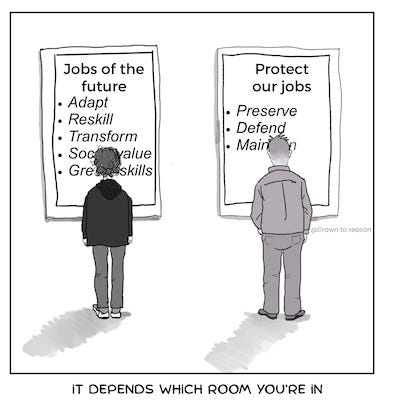
We tell young people, ‘The future will be different. You need to adapt’ and at the same time, Unions and politicians tell current workers, ‘Don’t worry, we’ll protect what you have.’ Those two messages can’t both be true.
Why resistance isn’t irrational
For those already in the workforce, this isn’t just about skills or retraining, it’s about identity.
Research on professional identity formation3 shows that our sense of self is shaped over time by social norms, training and workplace culture. It becomes embedded – reinforced by colleagues, status and lived experience.
So when change is framed as:
- “your job is disappearing”
- “your industry is the problem”
we are telling people ‘who you are no longer has value.’
Of course they resist! Not because they don’t understand the problem, but because the proposed solution feels like a personal loss (this is also why I try to be kind when the fossil fuel bods come for me — they’re trying to stay employed and I get that).
Meanwhile, young people are trying to make sense of the future.
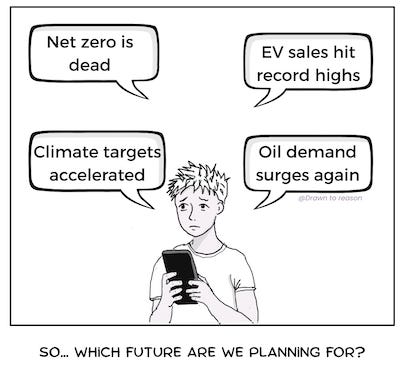
How should today’s young people decide what to be when they grow up?
(*NB. aging is inevitable, growing up is entirely optional).
Do you prepare for transformation?
Or assume things will largely stay the same?
Are we too fragmented?
This is where it goes beyond careers. Food systems, biodiversity loss, mental health, land use – these aren’t separate issues but we often present them that way for the sake of simplification.
If everything is bundled into one big system mess, it feels overwhelming. If it’s all split out, nothing connects. Either way, it becomes hard to see where you fit.
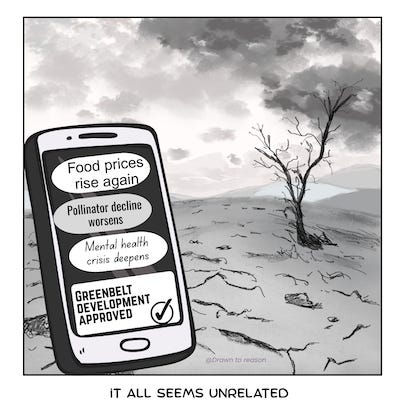
The real gap: identity
Put simply, we have an identity lag:
- professional identities shaped by the past
- signals about the future that don’t align
- and no clear story about what these roles mean now
So it’s no surprise people feel stuck – whether they’re starting out or already in the job.
What can educators do differently?
So what does this mean for educators?
1. Make the evolution of roles explicit
Don’t just teach engineering, design or economics, show how those roles are changing now, not in some distant future. Make visible:
- what counts as good practice now
- how expectations are shifting
- what “success” looks like in a changing world
86% of current students surveyed agreed that sustainability skills will be important to future employers whilst only half felt their education has prepared them for the changing world so there’s work to do to close this gap4.
2. Teach identities, not just pathways
Throwing more job titles at students isn’t really the answer. They need to be able to see themselves in the roles that already exist.
I find it refreshing that 71% of respondents to the above survey reported that they would choose a position with a starting salary of £1000 lower than average in a company with a strong environmental and social record. However, whilst 46% of respondents reported they would choose a position with a starting salary of £3000 lower than average, 54% would instead choose a position with a salary of £3000 higher in a role that does not contribute to positive environmental and social change ⁴.
This reflects the current contradiction. Young people need to be able to imagine:
- who they might become
- what they might stand for
- how their work connects to wider systems
That means exposing them to practitioners already doing this work and using examples that reflect current realities, not outdated norms.
3. Connect the dots
If everything is taught in silos, everything looks unrelated so we need to be unafraid to make the links explicit:
- food ↔ biodiversity ↔ health
- infrastructure ↔ climate ↔ inequality
Not as an add-on—but as the core of how the world works.
4. Acknowledge the transition honestly
Avoid the temptation to simplify the message. Students can handle complexity as long as it’s not framed as ‘the end of the world is nigh’. We need to be clear that:
- some roles will change significantly
- some industries will decline
- new opportunities will emerge—but not always neatly
Young people want honesty and action. We know that the majority (84%) globally are concerned about climate change5 with eco-anxiety being a growing issue for mental health6 so bringing that further into the curriculum and careers advice can really help give them agency and help them build a positive professional identity.
Conclusion
At ESD-Ex I saw a shift from the old ‘How do we prepare students for the future?’ to a more useful:
What kind of people does this future need and how do we help students see themselves in that — without pretending the transition will be simple?
1 Stryker S., Burke P. J. (2000). The past, present, and future of an identity theory. Social Psychology Quarterly, 63, 284-297.
2 Kasperiuniene, J., & Zydziunaite, V. (2019). A Systematic Literature Review on Professional Identity Construction in Social Media. Sage Open, 9(1).
3 Reissner, S., & Armitage-Chan, E. (2024). Manifestations of professional identity work: an integrative review of research in professional identity formation. Studies in Higher Education, 49(12), 2707–2722. https://doi.org/10.1080/03075079.2024.2322093
4 Students Organising for Sustainability UK (SOS-UK). (2025). Sustainability Skills Survey 2024-25: Higher Education.
5 Hickman C, Marks E, Pihkala P, Clayton S, Lewandowski RE, Mayall EE, Wray B, Mellor C, van Susteren L. (2021). Climate anxiety in children and young people and their beliefs about government responses to climate change: a global survey. Lancet Planet Health. Dec;5(12):e863-e873. doi: 10.1016/S2542-5196(21)00278-3.
6 M. Siyabend Kaya, Ed Hawkins, Ciara McCabe. (2026). Views on climate change, climate action and mental health, in young people with and without existing depression symptoms: A qualitative study. The Journal of Climate Change and Health. Volume 27, 100606.
