This is the seventh in our series of blog posts showcasing work presented at ESD Exchange. Emmanuel’s session takes place on day one of the ESD Exchange conference on April 16th 2026
This blog is based on my Applied Asset Management teaching activities within the DMU’s Trading Floor, and the development of a co-created ESG Trading Challenge inspired by leading students’ participation as a faculty advisor in the 2025 Global Bloomberg Trading Challenge presented at the session on day one of the ESD Exchange conference on April 16th, 2026.
- A sector-wide question
What if sustainability in finance education is not about adding ESG content, rather transforming how financial decision-making itself is taught?
Sustainability education has become an essential component of finance and financial studies as businesses, financial markets, and society increasingly demand sustainable practices in capital allocation and investment decision-making (Bendell et al., 2017). Across higher education institutions, sustainability is no longer peripheral but is now firmly embedded within institutional strategies, graduate attributes, and curriculum frameworks. Universities globally are aligning their programmes with the Sustainable Development Goals (SDGs), with a growing emphasis on preparing students to navigate an evolving financial landscape shaped by climate risk, regulatory change, and responsible investment imperatives for a rapidly changing world. Within this context, business schools are increasingly integrating sustainability principles into finance curricula in alignment with the United Nations’ Principles for Responsible Management Education (PRME), with the aim of fostering ethical reasoning, long-term value creation, and responsible financial decision-making (Bendell et al., 2017). However, in finance education a key challenge persists and raises a critical question for Education for Sustainable Development: that is, how do we move sustainability from conceptual awareness to meaningful, measurable, analytical practice and real-time financial decision-making?
The above question feels quite urgent in finance education. This is because sustainability is often introduced conceptually, and traditional finance curricula continue to prioritise optimisation models centred on return, risk, and benchmark performance. For example, students may be exposed to climate risk, ESG investing, or sustainable development in theory. In these settings, sustainability can appear as an ethical afterthought rather than a structural instrument of decision making. The challenge, herein, is not only whether sustainability is discussed, but whether it is meaningfully embedded in the methods, tools, and assessments during teaching and learning activities. Furthermore, within quantitative finance education, the challenge extends beyond the mere inclusion of sustainability content to its meaningful integration into the analytical frameworks that underpin financial modelling, portfolio construction, and risk assessment.
Consequently, a persistent gap remains between Environmental, Social and Governance (ESG) theory and real-world financial application. Students may develop an awareness of sustainable finance principles at a conceptual level but often lack the opportunity to operationalise these within live, data-driven decision-making environments. This disconnect limits their ability to interpret ESG factors as material drivers of financial performance, risk exposure, and long-term value creation, thereby constraining the development of practical green finance competencies required in contemporary financial markets.
This challenge is not only pedagogical but behavioural. Evidence suggests that finance education does not consistently translate into improved financial outcomes or participation (Lusardi et al., 2020; Harvey and Urban, 2023). In contrast, experiential approaches, where learners actively make decisions in simulated or real environments, have been shown to significantly enhance financial literacy and engagement (Batty et al., 2020, Morris, 2020). This raises an important pedagogical question for finance educators: What kind of learning environments enable students to experience sustainability as part of financial practice rather than as an abstract concept?
- What we’ve been doing: from global competition to curriculum innovation
At De Montfort University (DMU), I have been exploring this challenge through postgraduate Applied Asset Management teaching in Trading floor, which is not simply a specialist learning space, but also a state-of-the-art environment designed to simulate the realities of professional financial practice. Equipped with 48 terminals, industry-standard Bloomberg and LSEG Workspace, live ticker displays, multiple teaching and repeater screens, and a layout that supports collaborative market analysis, the trading floor provides a dynamic bridge between theory and real-time financial applications. What makes this especially valuable for ESD is that the trading floor offers the opportunity to embed sustainability into the actual architecture of learning.
A key motivation for this work emerged from my experience leading the Finance and Banking student team as a faculty advisor in the 2025 Global Bloomberg Trading Challenge. Students participated in a highly competitive, real-time global trading simulation involving thousands of teams worldwide. Their performance demonstrated not only strong engagement but also meaningful learning outcomes. For example, the overall best performing DMU team (called GoogleChampionsDMU) was ranked within the top quartile globally, achieving 345th position worldwide with positive returns and strong upward movement reflecting adaptability and strategic decision-making.
Across the cohort, students demonstrated:
- improved decision-making under real-time market conditions
- exposure to volatility and risk dynamics
- the ability to analyse and respond to real-time financial data
It is worth noting that even where performance varied, participation itself provided valuable experiential learning, placing students within a global competitive context and exposing them to the realities of financial markets. This experience became a turning point.
Although the Global Bloomberg Trading Challenge successfully helped in the development of technical trading skills, it also revealed a gap in that sustainability considerations were not systematically embedded in decision-making frameworks. This insight directly motivated the development of a co-created ESG Trading Challenge within the Applied Asset Management module.
3. Embedding Environmental, Social and Governance factors in real-time learning
In response to the above challenge, I developed a co-created ESG Trading Challenge within postgraduate Applied Asset Management teaching, delivered in DMU’s Trading Floor. This is not a simulated classroom exercise. It is a live, data-intensive environment where students interact with Bloomberg and LSEG Workspace platforms, analyse market movements, and construct portfolios in real time. The Trading Floor bridges theory and practice, enabling students to operate within conditions that closely resemble professional financial environments.
Within this setting, ESG is embedded directly into financial decision-making. Students construct portfolios where expected return and risk remain central, but ESG metrics are incorporated into asset selection, benchmarking, and performance evaluation. Portfolio performance is therefore assessed not only in financial terms but also through sustainability-adjusted indicators. Notably, the model is co-created in that students work in teams to design investment strategies, interpret ESG data, and justify decisions. This reflects evidence that collaborative and co-designed sustainability learning enhances awareness, responsibility, and professional readiness (Gulko et al., 2026).
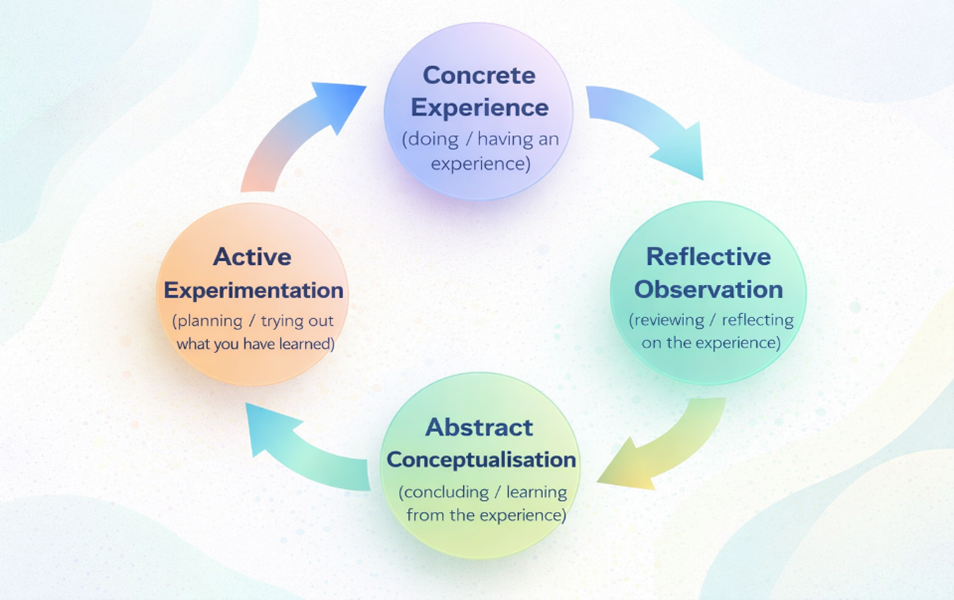
The approach is further grounded in Kolb’s experiential learning cycle (Kolb, 1984), where students:
- engage with live market data (Concrete experience)
- reflect on trading outcomes (reflective Observation)
- develop sustainability-informed strategies (Abstract conceptualisation)
- test and adapt decisions (Active experimentation) as depicted in Figure 1.
Consequentially, trading room environments have been shown to support this form of learning by providing authenticity, immediacy, and technical depth (Sharma et al., 2018).
| Figure 1: Kolb’s Experiential Learning Cycle |
- What are we noticing? ESG as a financial lens, not an ethical add-on
Several key patterns are emerging. The most significant shift is conceptual. Students are no longer treating ESG as a separate or optional consideration. Instead, they are beginning to understand sustainability as a factor that shapes risk exposure, asset pricing, and long-term portfolio performance. This aligns with emerging perspectives in finance and management education, which emphasise the development of dynamic capabilities that accounts for adaptability, systems thinking, and resilience in view of sustainability challenges.
At the same time, students are developing critical employability skills, which include higher-order analytical thinking, problem solving, and collaborative decision-making in areas that consistently identified as gaps in graduate readiness (Cavanagh et al., 2015). Admittedly, students are beginning to link financial decision-making with broader societal impact. Capital allocation is no longer viewed purely in terms of returns, but as a mechanism through which environmental and social outcomes are shaped. This relates vividly to findings from experiential and game-based learning, where immersive environments stimulate reflection and deeper understanding (Kolb and Kolb, 2009).
- Why this matters for Education for Sustainable Development (ESD) and finance education
This approach offers a practical pathway for embedding Education for Sustainable Development (ESD) within finance education. It demonstrates that: (i) sustainability can be integrated without compromising quantitative rigour, (ii) experiential learning enhances both engagement and competence, and (iii) co-creation transforms students into active participants in knowledge production.
Importantly, the model builds on existing infrastructure. It leverages platforms such as Bloomberg and LSEG Workspace rather than requiring extensive curriculum redesign, making it scalable and adaptable across institutions. It also responds to broader challenges in skills development, including fragmented curricula and the need for more integrated and inclusive approaches (Weishaupt et al., 2026). In finance, this requiresa shift from teaching about sustainability to embedding sustainability within financial models, tools, and decision frameworks. Digital platforms such as Bloomberg and LSEG play a critical role in enabling this transformation, reflecting the growing importance of technology in sustainability education.
Furthermore, this approach does not reduce the technical rigour in finance; it rather provides an extension. This is because students are required to engage with more complex datasets, integrate multiple performance dimensions, and justify decisions under real-world constraints. This aligns with findings from experiential and game-based learning research, which show that immersive and interactive environments stimulate reflection, engagement, and “aha moments” in sustainability-related decision-making (Højer et al., 2026). In other words, it provides alignments with the broader objective of preparing graduates who can operate in financial systems increasingly shaped by ESG regulation, climate risk, and stakeholder accountability.
- Rethinking how we evidence impact
A persistent challenge in both finance education and ESD is measuring impact. Traditional approaches focus on knowledge acquisition, yet evidence suggests that knowledge alone does not necessarily translate into behaviour (Carpena and Zia, 2020). Within the ESG Trading Challenge, impact is evidenced through: (i) trading performance and decision-making quality, (ii) engagement with ESG data, and (iii) reflective learning and reasoning. This shifts the focus from curriculum content to student capability and practice, where learning is demonstrated through action.
- What’s next? Scaling ESG in Finance Education
The ESG Trading Challenge provides a scalable model for embedding sustainability within finance curricula. Future directions include: (i) focussing on integrating ESG more explicitly into assessment design, expanding interdisciplinary collaboration, and strengthening links to industry practice, (ii) strengthening links between sustainability, employability, and professional practice, (iii) developing more structured assessment frameworks for measuring green skills. There is also potential to adapt this model across disciplines, particularly in areas where sustainability is not traditionally embedded.
- A closing reflection
The Global Bloomberg Trading Challenge demonstrated that students could perform at a high level in complex financial environments. The next step is ensuring that such performance reflects not only technical excellence but also responsible and sustainable decision-making. The experience of leading students in the Global Bloomberg Trading Challenge highlighted both the strengths and limitations of traditional experiential finance education. While students developed strong technical capabilities, sustainability remained peripheral. This work addresses that gap: What if sustainability is not something we add to finance education, but something that reshapes how financial decision-making is taught and experienced? By embedding ESG within real-time trading, co-created learning, and experiential frameworks, finance education can move beyond awareness toward actionable, measurable green skills. In other words, it becomes part of how they understand risk, responsibility, and their role in shaping future financial systems.
- Key takeaways
- Participation in the Global Bloomberg Trading Challenge demonstrated strong student capability and motivated curriculum innovation.
- Embedding ESG within trading activities enables sustainability to become a structural component of financial decision-making.
- Co-created and experiential learning approaches enhance engagement, reflection, and professional skill development.
- Real-time platforms such as Bloomberg and LSEG Workspace provide authentic environments for developing green finance competencies.
- The ESG Trading Challenge offers a scalable model for integrating ESD within finance education.
References
- Batty, M. et al. (2020) Economics of Education Review, 78, 102014.
Carpena, F. and Zia, B. (2020) Journal of Economic Behaviour & Organization, 177, pp. 143–184. - Bendell, J., Sutherland, N., & Little, R. (2017). Beyond unsustainable leadership: critical social theory for sustainable leadership. Sustainability Accounting, Management and Policy Journal, 8(4), 418-444.
- Cavanagh, J. et al. (2015) The International Journal of Management Education, 13(3), pp. 278–288.
- Gulko, N. et al. (2026) Journal of Accounting Education, 73, 101005.
- Harvey, M. and Urban, C. (2023) The Journal of the Economics of Ageing, 24, 100446.
- Kolb, D.A. (1984) Experiential learning: Experience as the source of learning and development. Englewood Cliffs, NJ: Prentice-Hall.
- Kolb, A. Y., & Kolb, D. A. (2009). ‚The learning way: Meta-cognitive aspects of experiential learning’. Simulation & gaming, 40(3), 297-327.
- Lusardi, A. et al. (2020) Economics of Education Review, 78, 101899.
- Morris, T. H. (2020). Experiential learning–a systematic review and revision of Kolb’s model. Interactive learning environments, 28(8), 1064-1077.
- Sharma, S. et al. (2018) The International Journal of Management Education, 16(3), pp. 541–557.
Contact details:
Dr. Emmanuel Senyo Fianu
De Montfort University
E-mail: Emmanuel.fianu@dmu.ac.uk
